When the Valtellina came under Graubünden rule (1512–1797),the wine trade intensified. The Swiss Confederates loved this mountain Nebbiolo and had up to 15,000 liters a day transported by mule toward Chur,Zurich,and Bohemia.
To meet such demand,the farmers of the Valtellina undertook a titanic effort: they terraced the valley slopes with dry-stone walls.
Valtellina: 2,500 km of dry-stone walls and UNESCO heritage
Today,these terraces form the largest mountain vineyard area in Italy: roughly 850 to 980 hectares of vines supported by 2,500 linear kilometers of dry-stone walls,built stone by stone without mortar,in pure equilibrium.
It is the most extensive masonry work in the Lombardy region,a highly visible monument that honors the generations who raised it.
In 2018,UNESCO inscribed "the art of dry-stone walling" on the Representative List of the Intangible Cultural Heritage of Humanity. It is a transnational recognition involving eight European countries (Italy,Croatia,Cyprus,France,Greece,Slovenia,Spain,and Switzerland) that protects a building technique handed down over centuries.
The Valtellina is one of the most representative Italian areas for this art,although its terraces are not formally included in the Nomination Dossier.
Above those walls,Chiavennasca finds exceptional growing conditions. The Rhaetian slope,facing south,receives well over 1,900 hours of sunshine per year.
This level of solar exposure is comparable to that received by Pantelleria,an island at the heart of the Mediterranean more than 1,000 kilometers to the south.
The Rhaetian Alps block the cold winds from the north,while the Orobie screen the warm winds from the south. The Breva,rising from the Lario,carries warm air that dries leaves and grape clusters.
It is a microclimate that can almost be called Mediterranean at 600 meters above sea level,in the midst of mountains that reach close to 4,000 meters.
The DOCG Valtellina Superiore has five sub-zones,each with its own character: Maroggia is the westernmost,Sassella the most celebrated and tannic,Grumello elegant and aromatic,Inferno the warmest and most powerful,Valgella the easternmost and most fragrant. Five shades of Nebbiolo that change from one bend of the valley to the next.
Brianza and Montevecchia: the Tuscany of Brianza
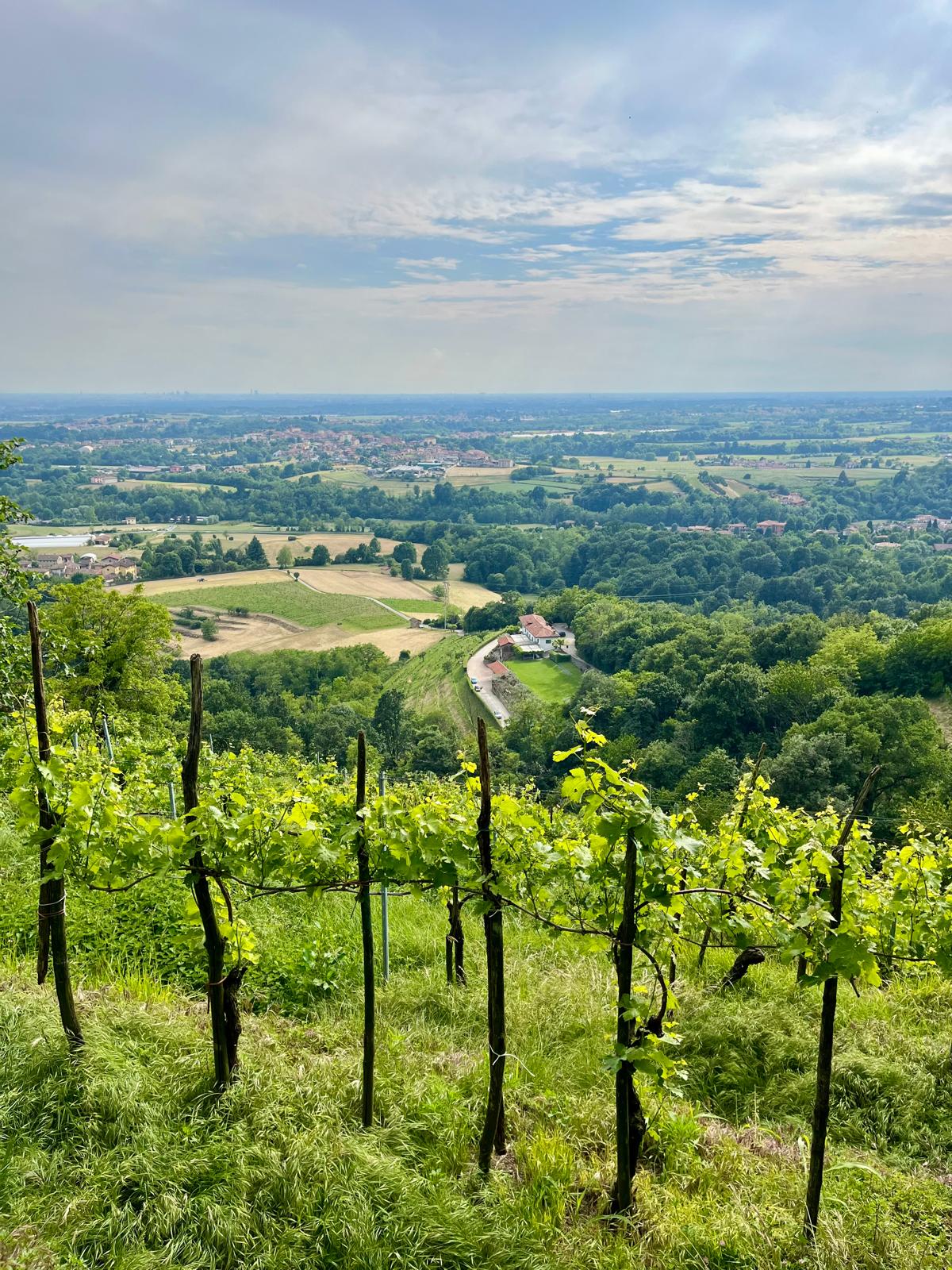
On the Brianza hills,between Lecco and Milan,viticulture has a quieter but equally ancient history. Cesare Cantù,in the opening of his Carlambrogio da Montevecchia (1836),describes Montevecchia as "a hill,from its foot to its summit smiling with terraced vines and orchards,with small fields and benches arranged in steps."
That description gave rise to the nickname "the Tuscany of Brianza."
Here too the vines grow on terraces,less spectacular and extensive than their Valtellina counterparts but equally ancient,built since the Middle Ages. The rows run along the edges of the terraces,in full sun,on clay-limestone soils rich in minerals.
The lake wind arrives gently,softened by the hills,but capable of bringing freshness through the warm summer nights.