I misteri di Villa Pliniana: Plinio, Leonardo e gli amanti

21 Maggio 2026

The Mysteries of Villa Pliniana: Pliny, Leonardo, and the Lovers

author

Lorenzo Bradanini e Lorenzo Tettamanti

Tempo di lettura: 12 minuti


Pliny,the pulsing spring,and the scandalous lovers: two mysteries of Torno

The sun has just dropped behind Monte Bisbino and the Breva has stopped blowing. Over the Como branch of the Lario settles that karstic silence that only deep lakes can produce: water that reflects the lights of the villages and reveals nothing of what lies beneath.

Four hundred and ten meters below,at the deepest point off Argegno. Deep enough to make it the fifth deepest lake in Europe,and at these depths,for two thousand years,someone has always believed something was hidden there.

Few people know that less than ten kilometers from Como,in a wooded inlet in the municipality of Torno,two mysteries exist side by side,close enough to touch: one geological,one human.

One is a spring that has pulsed since before the Roman Empire and that even Leonardo studied. The other is the story of a political murder,a fortress-villa built by the killer,a nineteenth-century love affair,and a ghost that probably never existed.

This is the first installment in a series on the mysteries of the Lario,told carefully and with rigorous documentation.

Pliny,Leonardo,and the siphon

The letter of 100 AD

Sometime between 96 and 109 AD,a lawyer from Como named Gaius Caecilius Secundus,whom history would know as Pliny the Younger,gathered and prepared for publication his collected correspondence. The result was an epistolary of 247 letters in nine books (plus a tenth,posthumous,containing his exchange with the Emperor Trajan).

Pliny was born in Como between 61 and 62 AD. His father died when he was a child and he was adopted by his maternal uncle,Pliny the Elder,himself born in Como in 23 AD and killed during the eruption of Vesuvius on August 24,79 AD — the day of the great Pompeian catastrophe that his seventeen-year-old nephew later described to Tacitus in two celebrated letters (Epistulae VI,16 and VI,20).

In the fourth book of the Epistulae,at letter number 30,Pliny the Younger addresses his friend Lucius Licinius Sura,a senator of Iberian origin,twice consul,and considered one of the sharpest naturalists of his time. The Latin opening is precise:

«C. Plinius Licinio Surae suo s. Attuli tibi ex patria mea pro munusculo quaestionem altissima ista eruditione dignissimam.»

"I have brought you from my homeland,in place of a small gift,a problem most worthy of your profound learning."

Pliny the Younger,Epistulae IV,30,1

He then describes the phenomenon with almost geometric precision:

«Fons oritur in monte,per saxa decurrit,excipitur cenatiuncula manu facta; ibi paulum retentus in Larium lacum decidit. Huius mira natura: ter in die statis auctibus ac diminutionibus crescit decrescitque.»

"A spring rises from the mountain,flows through the rocks,and is collected in a small man-made dining room; there,briefly retained,it falls into Lake Lario. Remarkable is its nature: three times a day it rises and falls with regular increases and decreases."

Epistulae IV,30,2

Pliny also describes an elegant experiment to demonstrate the phenomenon: a ring is placed on a dry stone,the water rises slowly until it covers it,then retreats gradually and leaves it uncovered again. His hypothesis (paragraph 5) is almost modern:

«Spiritusne aliquis occultior os fontis et fauces modo laxat modo includit?»

"Perhaps some hidden current of air alternately opens and closes the mouth and channels of the spring?"

There is also a more concise reference in Pliny the Elder: in Book II of the Naturalis Historia,published in 77 AD,in the chapter on "wonders of springs and rivers" (De mirabilibus fontium et fluminum),the phenomenon is recorded among the hydrological curiosities of the known world. That Book II is an encyclopedia of astronomy,meteorology,and the physics of the Earth,and the two Plinys are the only ancient authors to document this marvel.

An identification that is also a wager

Honesty is required here. The popular tradition of Como identifies with certainty the spring described by Pliny with the one that today pulses inside Villa Pliniana,at Torno. The problem is that classical historians are more cautious.

The Dictionary of Greek and Roman Geography edited by William Smith in 1854,an international reference for ancient geography,includes an important observation under the entry Larius Lacus:

"The name of Villa Pliniana is given at the present day to a villa about a mile beyond the village of Torno,where there is a remarkable intermittent spring,also described by Pliny (Plin. Ep. 4.30); but there is no reason to suppose that this was the site of either of his villas."

— W. Smith (ed.),Dictionary of Greek and Roman Geography,entry Larius Lacus,1854

In other words: the spring at Torno is indeed intermittent,the phenomenon matches,but the identification with the fons pliniana may be a Renaissance projection. The epithet "Pliniana" applied to the Torno site appears for the first time in documentation in 1494,in the account of the marriage of Maximilian I of Habsburg and Bianca Maria Sforza written by Tristano Calco. It is therefore a humanistic attribution,not a documented continuity.

That said: the spring at Torno is intermittent,it is the only known intermittent spring in the Lario area,and the phenomenon is identical to the one described by the Plinys. The probability that it is the very spring Pliny the Younger wrote about is very high,but — and this is what separates history from tourist myth — it has not been established with absolute certainty.

Leonardo and the Codex Leicester

Between 1482 and 1500,during his first stay in Milan at the court of Ludovico il Moro,Leonardo da Vinci worked on hydraulics for the Duchy. He studied the navigability of the Adda from Lecco to Milan (essential after the opening of the Martesana canal in 1465),searched for iron ore in the mountains of the Lario,and his notebooks contain precise notes on the Como territory.

In the Codex Leicester,the 72-page autograph manuscript now owned by Bill Gates and devoted entirely to the phenomena of water and the Earth,Leonardo mentions the spring at Torno with his characteristic spelling:

«fonte Priniana»

Leonardo da Vinci,Codex Leicester

The transcription error (Priniana instead of Pliniana) is typical of his notes,but the reference is unmistakable. The Codex Atlanticus as well — the largest collection of Vincian manuscripts,today at the Biblioteca Ambrosiana in Milan,dated 1478–1518 — contains related studies.

Leonardo was looking for a mechanical explanation for the phenomenon,consistent with his program of "reducing everything to measure." He did not find one,but his intuition that it was a hydraulic rather than magical behaviour — as had been believed until then — was the foundation on which the modern explanation would be built two centuries later.

What is actually underneath

The explanation accepted today was developed by the Torno scholar Pietro Müller (his monograph La Pliniana di Torno,Attilio Sampietro Editore,is in its second edition of 2000). It is a natural karstic siphon.

Inside the mountain there is a cavity that fills slowly with water through infiltration. When the water level reaches the top of the natural siphon connecting it to the outside,the siphon effect triggers: the cavity empties rapidly through the spring,until the water drops below the inlet of the siphon.

At that point the outflow stops,the cavity begins to refill,and the cycle starts again. The period is roughly eight to twelve hours; the "three times a day" of Pliny is considered a reasonable estimate.

The same mechanism explains a similar and geographically close phenomenon: the Fiumelatte,the intermittent stream that flows above Varenna,also mentioned by Leonardo. Two karstic phenomena unique across the entire Lombard Alpine arc,both on the Lario,both documented by ancient and Renaissance observers.

The villa,the assassin,and the lovers in the sheet

To reach the villa that today contains the spring,you must pass through one of the most sensational political crimes of sixteenth-century Italy.

On September 10,1547,in Piacenza,Pier Luigi Farnese was murdered. He had been born on November 19,1503,the illegitimate son of Cardinal Alessandro Farnese (elected pope Paul III in 1534) and of Silvia Ruffini. In 1545 his father,now pope,had granted him the newly created Duchy of Parma and Piacenza,carved out of the Papal States.

Pier Luigi was hated by the Piacenza nobility,who called him "the Pope's bastard",and by Emperor Charles V,who saw the duchy as an amputation of Spanish Milan.

The conspiracy was organized by a thirty-three-year-old Piacenza nobleman: Giovanni Anguissola,born in Piacenza in 1514,until shortly before in the service of Farnese himself. The plot also involved Aloisio Gonzaga,his brother-in-law,and had the political backing of Ferrante I Gonzaga,the Spanish governor of Milan. Pier Luigi was mortally wounded in the Visconti Castle of Piacenza and his body thrown into the moat.

For the Spanish,Anguissola became the man of the moment. In 1564,after years of service,he was given the governorship of Como: a Spanish appointment,since the Duchy of Milan was then under Philip II. In 1573 he purchased from a local nobleman,Gerolamo Gallo,the wooded plot at Torno where the intermittent spring rises. A few months later,work began on what he himself would choose to call Villa Pliniana.

The fortress-villa

The architectural attribution is today definitively assigned to Giovanni Antonio Piotti,known as il Vacallo (an architect active in the Como area),though recent studies have identified an earlier contribution by Pellegrino Tibaldi. The construction lasted three years and was completed in 1577.

The building is deliberately ambiguous: a facade with four rows of windows,a central Doric loggia,foundations set directly in the lake water,and a waterfall of about eighty meters behind it,dividing the mountainside. It is a pleasure villa but also a defended one,accessible mainly from the lake,positioned so the owner could see anyone approaching.

Anguissola had reason to be afraid. In his final years he survived two attempts on his life,which affected him deeply. He fell ill and died in Como on June 28,1578,before the villa was completed. His death came in bed,from natural causes: this is documented by the Dizionario Biografico degli Italiani.

Romantic popular legend tells a different story,however: that he was haunted by the ghost of Pier Luigi Farnese,who would appear at night at the lakeside door letting out the same cry he had uttered when run through by the daggers; and that one night,trying to seize it,Anguissola slipped into the waters of the Lario and never came back up.

Current historiography is clear in separating fact from legend:

"Despite its severe appearance due to its isolated position in the inlet of the lake,the villa is home to no ghost. In the past,ghost legends circulated due to unfounded popular traditions."

— entry Villa Pliniana,Wikipedia (based on Müller 2000 and Cani 2010)

The heir Giulio Anguissola sold the villa in 1590 to the Milanese nobleman Pirro I Visconti Borromeo,who completed it,had the surrounding land terraced for vines and chestnut trees,and commissioned the Como writer Gerolamo Borsieri to produce a treatise on the "flux and reflux of the Pliniana",gathering all the known explanations of the phenomenon.

The lovers in the sheet (1843–1851)

The real story that fed the ghost legend belongs to the nineteenth century and has documented protagonists.

On September 24,1824,in the church of San Fedele in Milan,a sixteen-year-old Cristina Trivulzio married the twenty-two-year-old prince Emilio Barbiano di Belgiojoso d'Este. She was the wealthiest heiress in Italy (dowry: 400,000 Austrian lire); he was a well-known libertine whom many had tried to dissuade her from marrying.

The marriage lasted a few years; there was never a formal divorce,only a consensual separation. Cristina would go on to become one of the most important figures of the Italian Risorgimento: a Mazzinian patriot,journalist,and author of Della presente condizione delle donne e del loro avvenire (1866). Emilio took the road of dissipation.

In 1840 Emilio Barbiano di Belgiojoso bought Villa Pliniana,which since 1831 had passed through three minor owners,among them the patriots Filippo Caronti and Gino Daelli. He planned a complete redecoration of the interiors.

A few years later,in Paris,Emilio met Anne-Marie Berthier,Princess of Wagram and Duchess of Plaisance. She was the daughter of Marshal Louis-Alexandre Berthier,Napoleon's chief of staff,and the niece of the Duchess of Birkenfeld.

She was married to the Duke of Plaisance and had a newborn daughter. Between 1842 and 1843 the two fled Paris together,abandoning their respective spouses and her child,and took refuge at Villa Pliniana. They would live there for eight years,from 1843 to 1851,in near-total isolation.

This is where the legend takes root. Popular accounts,collected by Magda Martini in the book Gli amanti della Pliniana (2003),tell that every night at the stroke of midnight the two would wrap themselves naked together in a white sheet and leap from the loggia directly into the Lario,in a daily ritual of love to "calm the fever of passion that consumed them."

The villagers on the opposite shore — Moltrasio is barely half a kilometer away as the crow flies — saw every night at the same hour a white figure plunging from the loggia into the dark water. They concluded it was a ghost.

For years the story circulated that at the stroke of midnight the spirit of Anguissola,or of his Farnese,threw itself into the dark lake.

It was love. It was exhibitionism. It was perhaps also a deliberate defiance of the conventions of the time,one that the couple could only afford by shutting themselves away in a genuinely private property on the lake.

The story ends badly. Anne-Marie suddenly left Emilio while he slept and moved to Milan,resuming her social life and buying a box at La Scala. Emilio remained confined to the villa for some years. He contracted syphilis and died in 1858,in a state of delirium,in the family palazzo in Milan. Cristina Trivulzio,still his wife on paper,outlived him until 1871.

Antonio Fogazzaro used the atmosphere of the villa as the setting for his decadent novel Malombra (1881),and Mario Soldati adapted it into a film of the same name in 1942,which helped crystallize the gothic myth of the Pliniana. Among the villa's documented guests across two centuries: Stendhal,Lord Byron,Ugo Foscolo,Vincenzo Bellini,Gioachino Rossini (who according to tradition composed the Tancredi there in three days,though the dating is uncertain),Alessandro Volta on a visit in 1785 with Carlo Amoretti,Emperor Joseph II of Austria,and even Napoleon Bonaparte,who stayed briefly in 1797 and later considered buying the villa as a retreat.
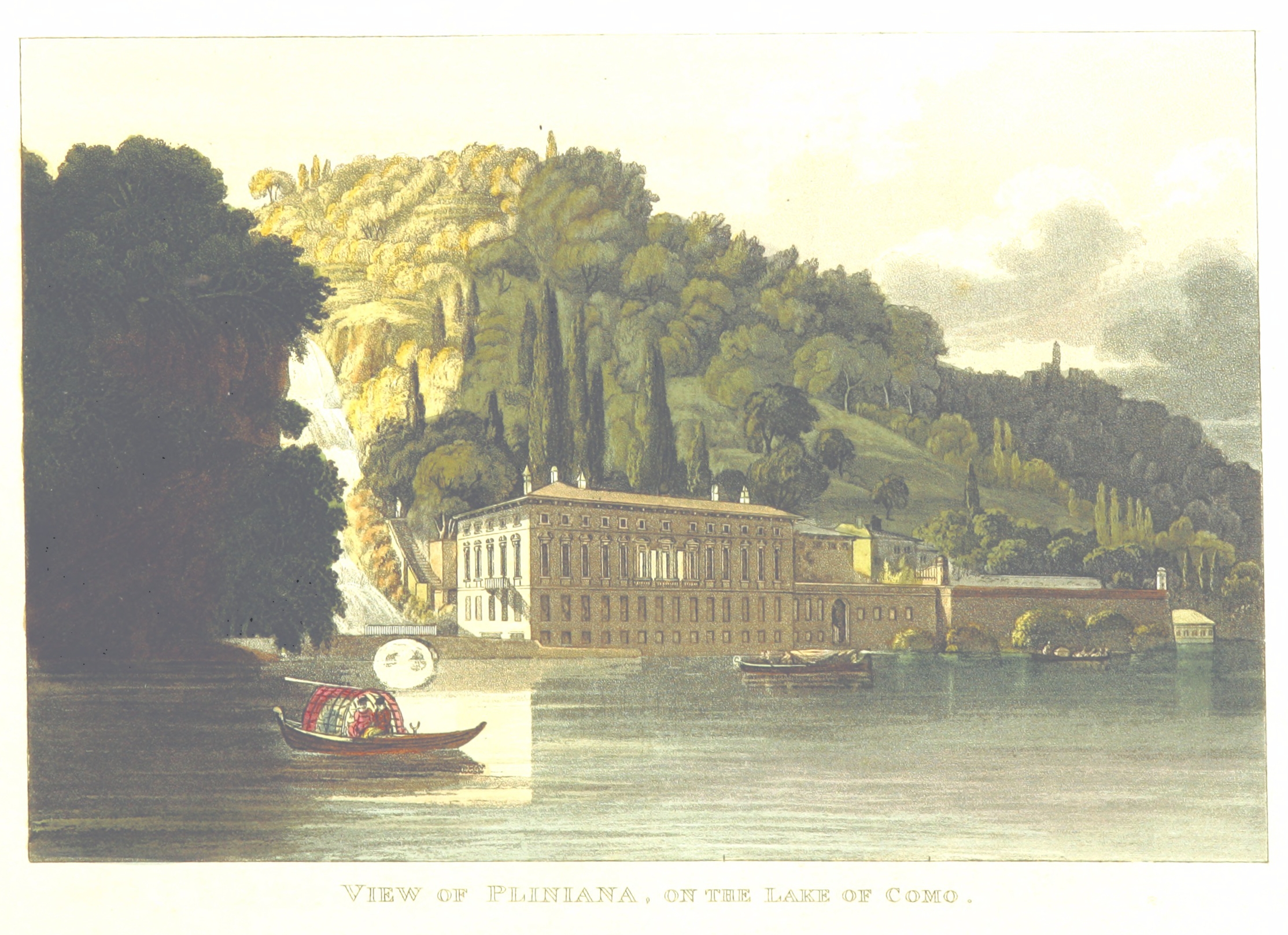
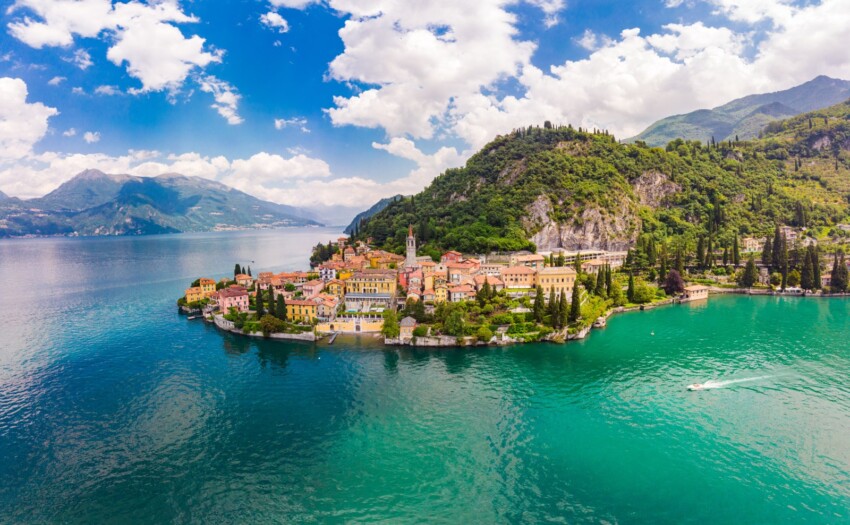
Villa Pliniana and the village of Torno

Villa Pliniana

Today it is a private property managed by the Sereno Hotels group as a luxury residence available for exclusive stays and events. The intermittent spring is inside the villa's courtyard and is not freely accessible to the public. The waterfall behind it,roughly eighty meters high,is clearly visible from the lake.

The most evocative and legitimate way to see the villa is from the water: the Navigazione Lago di Como operates scheduled services that pass in front of the Pliniana (the Como–Bellagio line,Torno stop). By private or hired boat you can approach the facade to within a few dozen meters. The view at sunset,with the waterfall dropping directly onto the water and the sixteenth-century facade emerging from the green,is exactly what struck Stendhal and Byron.

The cultural association Iubilantes (based in Como) periodically organizes,often on the occasion of Leonardian or Plinian anniversaries,special openings with guided visits to the spring. Checking their schedule is genuinely worthwhile.

The village of Torno

Beyond the villa,the following are well worth a visit:

  • the church of San Giovanni Battista (twelfth century,with a Renaissance portal by the school of the Rodari,the same craftsmen responsible for the sculptures of Como Cathedral)
  • the church of Santa Tecla on the lakeshore

The village is reachable from Como in thirty minutes by ferry or fifteen by car.

Some recurring questions

Is the spring at Villa Pliniana really Pliny's spring?

Almost certainly yes,but with an asterisk. The spring at Torno is indeed intermittent,the phenomenon matches the Plinian description point for point,and it is the only spring of this kind on the Lario. However,the identification is a humanistic tradition documented only from 1494 (Tristano Calco),and William Smith's Dictionary of Greek and Roman Geography (1854) notes that there is no proof the site corresponds to either of Pliny's villas. It is probable,not certain.

Was Anguissola really killed by the ghost of Farnese?

No. Giovanni Anguissola died in his bed in Como on June 28,1578,after falling ill following two attempts on his life in his final years. The romantic legend of Farnese's ghost is a later overlay,fed by the atmosphere of the villa and by Fogazzaro's novel Malombra (1881). Current historiography — Müller,Cani,and the Dizionario Biografico degli Italiani — is unambiguous in separating fact from legend.

Can you visit Villa Pliniana?

The villa is private property managed by Sereno Hotels as a luxury residence for exclusive stays. There is no free public access. It is best seen from the lake: the scheduled Como–Bellagio ferry service passes directly in front of the facade,and private boats can come within close range. For special openings,the Iubilantes association in Como organizes guided visits on particular occasions.

Did Leonardo really study the spring?

Yes. He mentions it explicitly in the Codex Leicester (with his characteristic spelling «fonte Priniana»),the autograph manuscript dedicated entirely to the phenomena of water. He probably visited it in person during his first stay in Milan (1482–1500),when he was engaged in hydraulic studies on the Lario and the Adda for the Duchy. Alessandro Volta,born in Como,also went there with Carlo Amoretti in 1785.

How deep is Lake Como,really?

410 meters at its deepest point,off Argegno,on the Como branch. It is the fifth deepest lake in Europe,with a surface area of roughly 146 km².

The grand finale

Two mysteries two hundred meters apart,separated by fifteen centuries. On one side a natural karstic siphon that has pulsed since before Christ and occupied the minds of Pliny the Younger (Epistulae IV,30 — around 100 AD),Pliny the Elder (Naturalis Historia II,106 — 77 AD),and Leonardo da Vinci (Codex Leicester,late fifteenth century).

On the other,a fortress-villa built in 1573 by a political assassin,inhabited for eight years by the most scandalous lovers in half of Europe,mythologized by Fogazzaro and Soldati.

The true mysteries of Lake Como are not made of prehistoric monsters and nocturnal ghosts. They are made of water that obeys geology with the regularity of a clock,of archival documents that resist time,of Latin letters still legible after two thousand years,of political murders and love affairs documented day by day.

Legend arises where history pauses for a moment: the ghost of Farnese in place of Anguissola's illness,a specter in place of the naked lovers. But history is almost always more interesting than legend,if it is told with care.

Torno is there,reachable in thirty minutes by ferry from Como. The spring continues to pulse every eight to twelve hours. The villa continues to look melancholy at dusk. And the documents,those,remain.

Cheers,and keep your eyes open.