L'isola maledetta del Lario: la scomunica e il rito del fuoco

29 Maggio 2026

The Cursed Island of Lake Como: Excommunication and the Rite of Fire

author

Lorenzo Tettamanti e Lorenzo Bradanini

Tempo di lettura: 10 minuti


The cursed island of the Lario

Comacina,the only island on Lake Como,was razed to the ground,left uninhabited for eight centuries,and "condemned" by a formula that everyone cites as a bishop's curse. The documents,however,tell a different story — and a more interesting one.

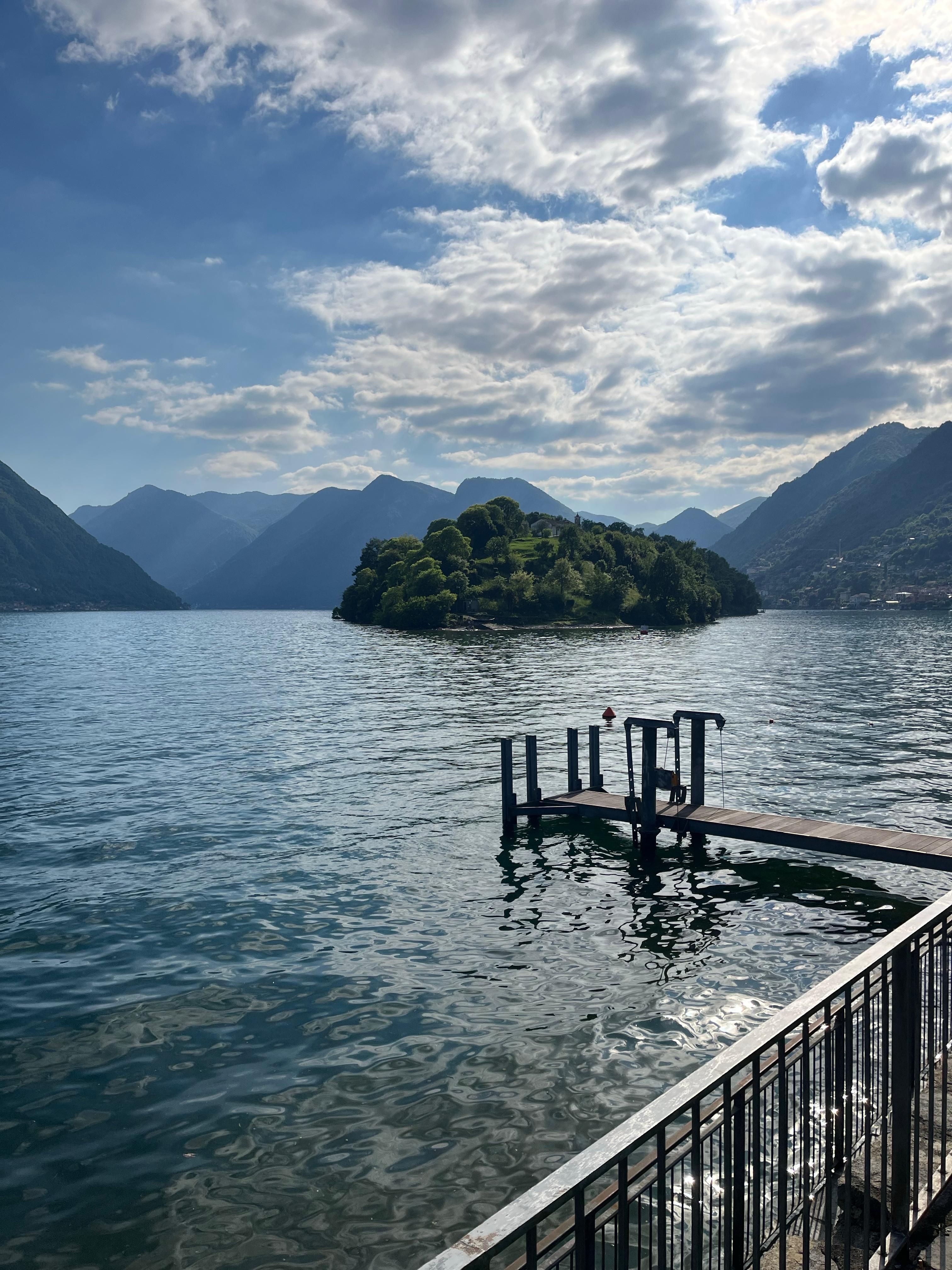
There is a point on the Como branch of the lake,where it faces south and narrows between Sala Comacina and the tip of Balbianello,where the only true island of the Lario breaks the surface: a spindle of rock and green,just over six hundred meters long and little more than two hundred wide.

From Ossuccio,on the opposite shore,it looks close enough to touch: barely a hundred meters of water separate it from the mainland.

And yet for nearly eight hundred years,on that strip of land within rowing distance,nobody lived. Not by chance. Not through neglect. But because,according to tradition,a bishop had condemned it.

This is the second installment in the series on the mysteries of the Lario. In the first,we followed a spring that has pulsed since before the Roman Empire and a villa-fortress built by a murderer,at Torno.

Here we move about ten kilometers,to the village of Lenno,to tell the story of an island destroyed in a single day,a curse that was probably never pronounced by the person we think,and three men who in the twentieth century had the courage — or the recklessness — to go back.

As always: carefully,keeping the document separate from the legend.

A scrap of land worth a war

Isola Comacina is not large at all,but it is truly one of a kind. And in a lake like the Lario,410 meters deep and dozens of kilometers long,the only fortifiable point in the middle of the water is worth,militarily,far more than its surface area.

Inhabited since Roman times,the island served as refuge and stronghold: for the Byzantines against the Lombards in the sixth century,and then for the Lombards themselves.

In the Middle Ages it became a small autonomous citadel,home to a pieve (the so-called "pieve d'Isola"),and according to tradition recorded by a local historian,it once held up to nine churches on that single rock. The basilica of Sant'Eufemia,of which only ruins remain today,is said to have been refounded in the eleventh century as part of a reorganization of the diocese of Como.

It was,in short,a wealthy,fortified,and proud place. A little too proud for its times.

1169: how you destroy an island in a day

To understand the end you have to start with the Decennial War (1118–1127),the long conflict between Como and Milan for control of the waterways and Alpine passes.

From that war an exceptional account has survived: the Liber Cumanus,sive de bello mediolanensium adversus comenses,a Latin epic poem by an anonymous poet from Como,the Anonymous of Como,who states in the prologue that he was a direct witness to the events.

In that conflict,Comacina — ambitious and eager to dominate the lake — chose to side with Milan. It was the wrong choice: Como,though defeated militarily (the city capitulated in 1127 and had its walls torn down),did not forget.

When the tide of history turned,Como allied itself with Emperor Frederick Barbarossa,enemy of the Lombard League,and with his support contributed to Milan's defeat. At that point it was time to settle accounts.

On June 24,1169,the feast of Saint John the Baptist,the warriors of Como,joined by the men of the Tre Pievi (Dongo,Gravedona,Sorico) and with imperial backing,invaded Comacina.

The island was put to the sword and torch: the fortifications demolished so they could never be rebuilt,the churches razed to the ground (one alone,according to tradition,was spared). The few survivors fled to the opposite shore,to Varenna,which for a time was called insula Nova — the "new island" — for this reason.

That day ended the history of Comacina as a community. The history of Comacina as a cursed place began.

The curse that was (perhaps) not a curse

Here the same honesty is required that we used for the spring at Torno.

Dozens of articles circulate online telling the same scene: after the destruction,the Bishop of Como Vidulfo (also spelled Vidulfio,or Bidulfo) supposedly cast a solemn excommunication over the island:

"The bells shall ring no more,no stone shall be laid upon stone,no one shall ever keep an inn here again,on pain of violent death."

It is a powerful formula,perfect for a mystery blog. The problem is that the documentary source tells something slightly,but decisively,different.

The Wikipedia entry for Isola Comacina,and the historiography it draws on,attributes those words not to a bishop's excommunication of 1169,but to an imperial decree issued by Frederick Barbarossa in 1175,by which the emperor confirmed the ban on rebuilding fortresses,churches,and houses on the island.

In other words: the phrase that everyone cites as "the bishop's curse" is documented as a war edict — a political and military act designed to prevent the enemy stronghold from coming back into existence.

The difference is enormous. An excommunication is supernatural; a decree is a surrender clause. The first explains eight hundred years of abandonment through the fear of God; the second explains it through geopolitics,economics,and medieval law — exactly as,on the other shore,the spring at Torno "pulses" because of a karstic siphon and not because of magic.

This does not mean that the figure of the bishop is pure invention: the popular tradition of Como stitched the name of a prelate and the language of the anathema onto that prohibition,and it is from that stitching that the legend was born.

But the certain identification of a "Bishop Vidulfo" pronouncing that exact phrase in 1169 belongs to folklore,not to the archives. The document says emperor,year 1175,ban on reconstruction.

That said,the effect was real. For nearly eight hundred years nobody rebuilt anything permanently there. Whether the cause was fear of excommunication or respect for the imperial edict,the result is the same: the island remained a graveyard of ruins overrun by snakes.

Until 1947.

The men who defied the sentence

In the postwar years three men decided the time had come to break the spell and open a restaurant right there,on the "condemned" island.

They were the Como silk merchant Carlo Sacchi,the motorboat racing champion Sandro De Col,and an innkeeper known to everyone as "Cotoletta" — Lino Nessi by his real name. They founded a club,"Amici dell'Isola," and began work.

Then the misfortunes began. Sandro De Col died in a motorboat accident. Carlo Sacchi was shot dead during a gala evening at Villa d'Este in Cernobbio: the woman who killed him was his lover,the Countess Pia Bellentani,in one of the most sensational criminal cases in Italy in 1948.

Two of the three partners,both dead by violent deaths — exactly as the formula itself had foretold.

Cotoletta,understandably shaken,considered walking away from the whole thing. It was then that an English writer staying on the lake,Francis Dale,who knew the story of the island,stepped in and suggested a remedy: an ancient fire ritual,an exorcism that,according to the tradition she described,had its roots in the propitiatory rites of the first Greek and Roman settlers on the Lario.

The ritual was performed. The work was completed without further deaths. And since then,the Locanda has always said,"nobody has died anymore."

To be on the safe side,Cotoletta decided to repeat the exorcism at every single meal served. Still today,at the end of lunch,in front of all the guests together,a burning mixture of grappa,sugar,and coffee is prepared,accompanied by the sound of a bell: it is the famous "coffee with the fire ritual," a small theater of flames that symbolically exorcises the curse of 1169.

The menu of the Locanda,fixed since the days of Cotoletta,remained almost unchanged for decades — so immovable that at a certain point there were calls to protect it as a piece of cultural heritage.

An important practical note. The historic Locanda run by the Puricelli family (heirs of Cotoletta) has been closed since October 2019 following a dispute with the owner,the Fondazione Isola Comacina (which includes the Accademia di Brera). The island remains visitable,and the catering arrangements have been the subject of new concession procedures: before planning a meal on the island,check the current opening status.

The fire ritual is a tradition tied to that specific management: assuming you will find it in operation is,today,a gamble.

The King of the Belgians and the artists' houses

There is a chapter that almost nobody knows,and that alone would be worth the trip.

The last private owner of the island was Augusto Caprani,a hotelier and former mayor of Sala Comacina. During the First World War,out of admiration for Belgium's heroic resistance,he decided to leave his "island property" to King Albert I of Belgium.

At Caprani's death,around 1919,the king accepted the unusual inheritance and in 1920 donated it to the Italian State,with the idea of turning it into a holiday colony for Italian and Belgian artists. Management was entrusted,thanks to the involvement of its president,to the Accademia di Belle Arti di Brera in Milan.

From that project came the three "houses for artists",designed by the architect Pietro Lingeri,born at Bolvedro di Tremezzo,just a short distance from the island,and one of the fathers of Italian Rationalism alongside Terragni.

Commissioned in the early 1930s and completed between 1938 and 1940,they are three spare volumes of Moltrasio stone and wood,a modern reinterpretation of Lario vernacular architecture inspired by Le Corbusier's holiday houses. Restored between 2009 and 2010,they now host creative residencies and cultural events.

So on this same rock,the ruins of an early Christian basilica and three masterpieces of modernism exist side by side. From Frederick Barbarossa to Le Corbusier,by way of a King of the Belgians: few places in Italy have a comparable density of history per square meter.

(And a detail for film lovers: in 1925 a young Alfred Hitchcock,according to tradition,shot some scenes here for his first film,The Pleasure Garden.)

And the Holy Grail? Steady on.

If you search "Isola Comacina mystery" you will sooner or later come across the legend that the Holy Grail was hidden here,kept at the end of the sixth century by Pope Gregory the Great before its transfer to Rome,complete with Templar Knights for good measure.

It is a fascinating story and should be taken for what it is: devotional tradition and suggestion,not document. The island certainly played a prominent religious role in the early Middle Ages,and that is more than enough to explain why the story arose.

But between "important Christian center" and "hiding place of the chalice of Christ" lies the same distance that separates history from myth. We,as usual,stop where the evidence ends.

When to go,and what to see

The perfect moment: the Sagra di San Giovanni. It is the oldest festival on Lake Como and stages,every year,a reenactment of the burning of 1169. In 2026 the fireworks are scheduled for the evening of Saturday,June 27,with the solemn procession and the Holy Mass among the ruins of Sant'Eufemia on Sunday,June 28.

The pyrotechnic and musical display,one of the most spectacular on the Lario,normally begins after 10 PM and lasts nearly an hour,with hundreds of illuminated boats forming a backdrop around the island.

Added to this is the ancient tradition of the lumaghitt: small lights made from the empty shells of snails (the ritual dish of the feast was polenta and snails) and the regatta of the lucie,the lake's historic rowing boats.

How to get there. The island is reachable in a few minutes by taxi-boat from Sala Comacina and Ossuccio,or by the scheduled ferries of Navigazione Lago di Como.

On the days of the Sagra,the best way to enjoy the fireworks is from the water,with a small boat cruise: book well in advance.

What to see once you've landed:

  • The ruins of the basilica of Sant'Eufemia,the archaeological heart of the island and one of the most important early medieval sites in northern Italy.

  • The church of San Giovanni,rebuilt in the seventeenth century,and the traces of the other ancient churches.

  • The three artists' houses by Lingeri,along the "Sentiero degli artisti": a short pilgrimage for anyone who cares about Rationalist architecture.

  • At Ossuccio,on the mainland opposite,the Museo Antiquarium,which holds the finds excavated on the island,and above it the Sacro Monte della Beata Vergine del Soccorso,a UNESCO World Heritage Site.

Bring comfortable shoes and,even in summer,something to cover up with: on the lake at dusk,there is always a breath of wind.

Some recurring questions

Why is Isola Comacina considered cursed? Because after the destruction of 1169 it remained uninhabited for nearly eight hundred years. Popular tradition attributes this abandonment to a curse cast by the Bishop of Como,Vidulfo. The documents,however,trace the famous formula ("no stone shall be laid upon stone...") to an imperial decree issued by Frederick Barbarossa in 1175,which banned reconstruction: a military edict rather than a religious curse.

Who destroyed Isola Comacina? The people of Como,allied with Frederick Barbarossa and aided by the Tre Pievi,on June 24,1169. It was an act of revenge: during the Decennial War (1118–1127) the island had sided with Milan against Como.

Is it true that the founders of the restaurant died? Two of the three,yes. Sandro De Col died in a motorboat accident; Carlo Sacchi was shot dead by the Countess Pia Bellentani at Villa d'Este in 1948. The third partner,Lino "Cotoletta" Nessi,had a fire ritual of exorcism performed and carried the Locanda forward. This is the origin of the tradition of the "coffee with the fire ritual."

Can you visit Isola Comacina? Yes. It is reachable by taxi-boat from Sala Comacina and Ossuccio,or by the scheduled ferries. Visitors can see the archaeological remains,the church of San Giovanni,and the three Rationalist houses by Pietro Lingeri. The historic Locanda has been closed since 2019 due to a legal dispute: check the current status of the catering service before you set out.

When is the Sagra di San Giovanni 2026? The fireworks are expected on Saturday,June 27,2026; the procession and Mass on the island take place on Sunday,June 28. It is the oldest festival on Lake Como and commemorates the burning of 1169.

What do the King of the Belgians and the artists have to do with it? The last owner,Augusto Caprani,left the island to King Albert I of Belgium,who in 1920 donated it to the Italian State. Placed under the management of the Accademia di Brera,it became the site of a colony for artists,from which the three Rationalist houses built by Pietro Lingeri between 1938 and 1940 were born.

The grand finale

Two mysteries,once again,separated by a few centuries and a few hundred meters of water.

On one side the documented history: a small island republic that bets on Milan and loses everything; an emperor who,by a decree of 1175,forbids it from coming back into existence; eight centuries of silence; a King of the Belgians who gives the island to Italy; an architect from the lake shore who builds three modern masterpieces on it.

On the other,the legend: a bishop who pronounces a curse,a sentence of "violent death" that seems to pursue anyone who dares return,a fire exorcism repeated at every meal to keep disaster at bay.

As with the spring at Torno,the truth is no less fascinating than the myth: it is simply more precise. The fascination of Comacina lies not in the curse of a bishop who perhaps never uttered it,but in the consistency with which history — war,law,art — has shaped a scrap of rock in the middle of the lake,leaving it empty long enough to become legend.

The island is there,a hundred meters from the shore at Ossuccio,reachable in a few minutes by boat. The ruins continue to keep their silence. Lingeri's houses continue to look out over the water. And every year,at the end of June,the lake lights up again to remember the day when everything ended.

Cheers,and keep your eyes open.


This is the second installment in the series on the mysteries of the Lario. If you enjoyed it,pass it on: the next piece of history is already in the works.


Go to previous article

Go to next article