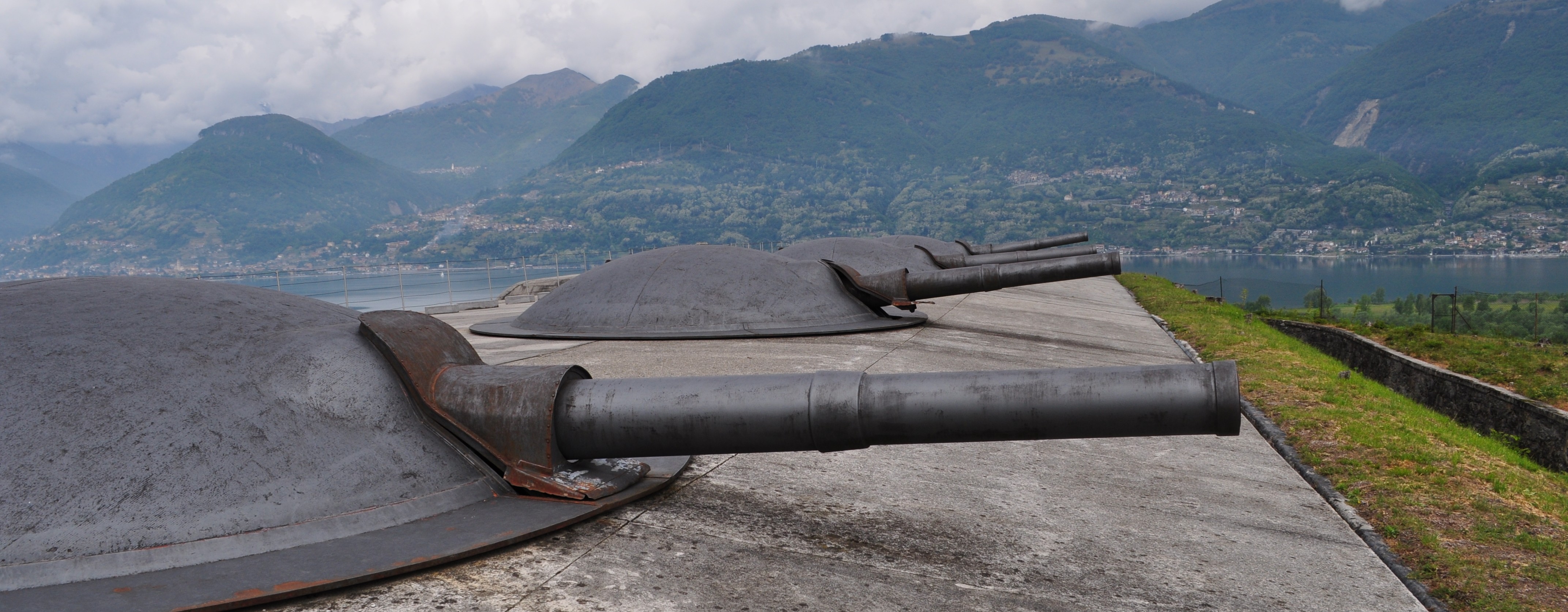
The visit starts from the bottom, at the barracks, at an altitude of 258 metres. It is a block set into the hill, built largely with San Fedelino granite, with concrete and stone walls between one and a half and two metres thick, designed to withstand direct hits from medium-calibre artillery. Between the wall and the rock runs a seventy-centimetre cavity that kept moisture away.
The troops slept in a single heated dormitory, with about forty bunks; next to it were the quartermaster's office, the infirmary, the armoury, with its rack still in place, and the command, with a large hand-painted map of the territory on the wall. On the parade ground one can still make out the garrison's bocce court.
From the barracks to the battery one climbs along a covered passage of about 140 metres, two and a half metres wide and three high, leaning against the mountain on one side and protected on the other by a metre and a half of reinforced concrete, with ten loopholes in worked granite. Halfway along, a side tunnel enters the rock: it is the powder magazine, and here every detail speaks of the fear of fire. The six explosives storerooms open staggered, so that no door faces another. The floor is wood fixed with bronze nails, which do not make sparks.
Under the vault runs a sheet of galvanised metal on which moisture condenses and then slides into gutters at the sides of the corridor. A little further on are two small rooms where fuzes and shells were armed, and their outer walls were deliberately left unfortified: in case of an accidental explosion, the blast was meant to vent outside and not inside the passage.
The battery proper is on two floors. On the ground floor are the ammunition stores, three large rooms dug into the rock, and the engine room, the heart of the fort. Electricity came from dynamos driven by internal combustion engines, four lead accumulators maintained a constant voltage of 120 volts, and the knife switches are mounted on marble panels by Ercole Marelli of Milan. A forced ventilation system brought fresh air into the rooms and drew out the fumes of the guns and engines, also because in summer temperatures under the domes could exceed forty degrees.
The fumes did not exit from above, where they would have revealed the fort's position: they were pushed into a tunnel of about fifty metres and discharged into the woods, outside the walls. Those from the engines first passed through a water tank that cooled them and turned them white, making them harder to notice.
Hand-operated hoists lifted shells and charges to the first floor, along a sixty-metre corridor onto which open the storerooms and the stairs of the four turrets. Here is the command room, where the firing data were set, that is, the type of shell, the charge, the elevation and the direction. It has an observation turret, a telephone panel and an intercom made of copper tubes to speak with the storerooms and the turrets.